Sunday
A self-hosted project manager for small teams, without the seat price. Plan before Monday comes.
- Type
- Product, 2026
- Role
- Solo, design and build
- Status
- Open source, self-hosted
- Rule
- Refuse the feature, keep the speed
Why
At work we run on Monday, Trello and the rest of that family, so reaching for one of them for my own projects was the obvious thing to do. It was also wrong. Every one of them is priced and shaped around an organisation chart, and most of that surface never gets switched on.
What planning actually needs is narrow: split the work into tasks, label them, and see at a glance where a project stands. What ships instead is permissions, workflows, automations and integrations, each one adding a little weight to the thing you open twenty times a day.
The weight is the real cost. A planning tool that takes two seconds to load is a planning tool you stop loading, and your data sits on someone else's server for the privilege.
How
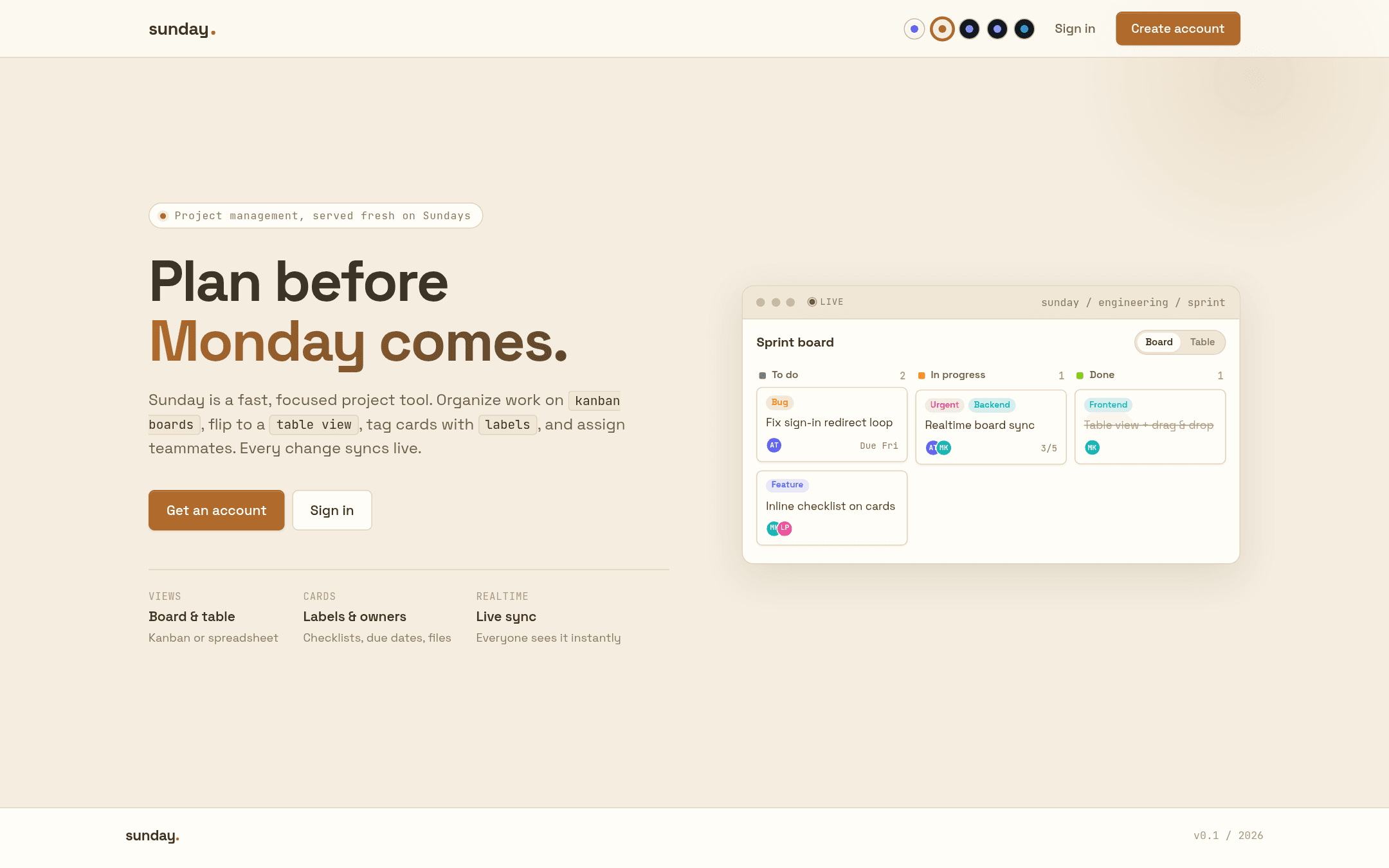
I built the subset that earns its keep and refused the rest. Workspaces, boards, kanban and table views, cards with labels, assignees, checklists, attachments and threaded comments. Nothing that needs a manual.
Speed came first rather than last: server-sent events for live sync instead of a heavier real-time stack, and a schema designed around the views that actually get opened.
It is self-hostable by design. One Docker Compose file brings up the whole thing, the data stays on your own machine, and there is no account to create. Auth, email invites, per-board custom fields and optional S3-compatible storage cover real team use without the seat price.
The MCP server is the part I did not expect to lean on. Boards are readable and writable by an agent, so tasks get created, moved and closed from wherever the work is already happening.
Outcome
A planning tool that opens instantly, holds every project I run, and scales from one person to a small team without a pricing page.
Self-hosted end to end: your infrastructure, your database, your data, no vendor to trust.
The code is public under an open source licence, so anyone can run it, fork it, or lift the pieces they need.
Gallery04
Built with
Next.js 16, TypeScript, Drizzle, MariaDB, SSE, Docker
View the source